
Publications
On-going works
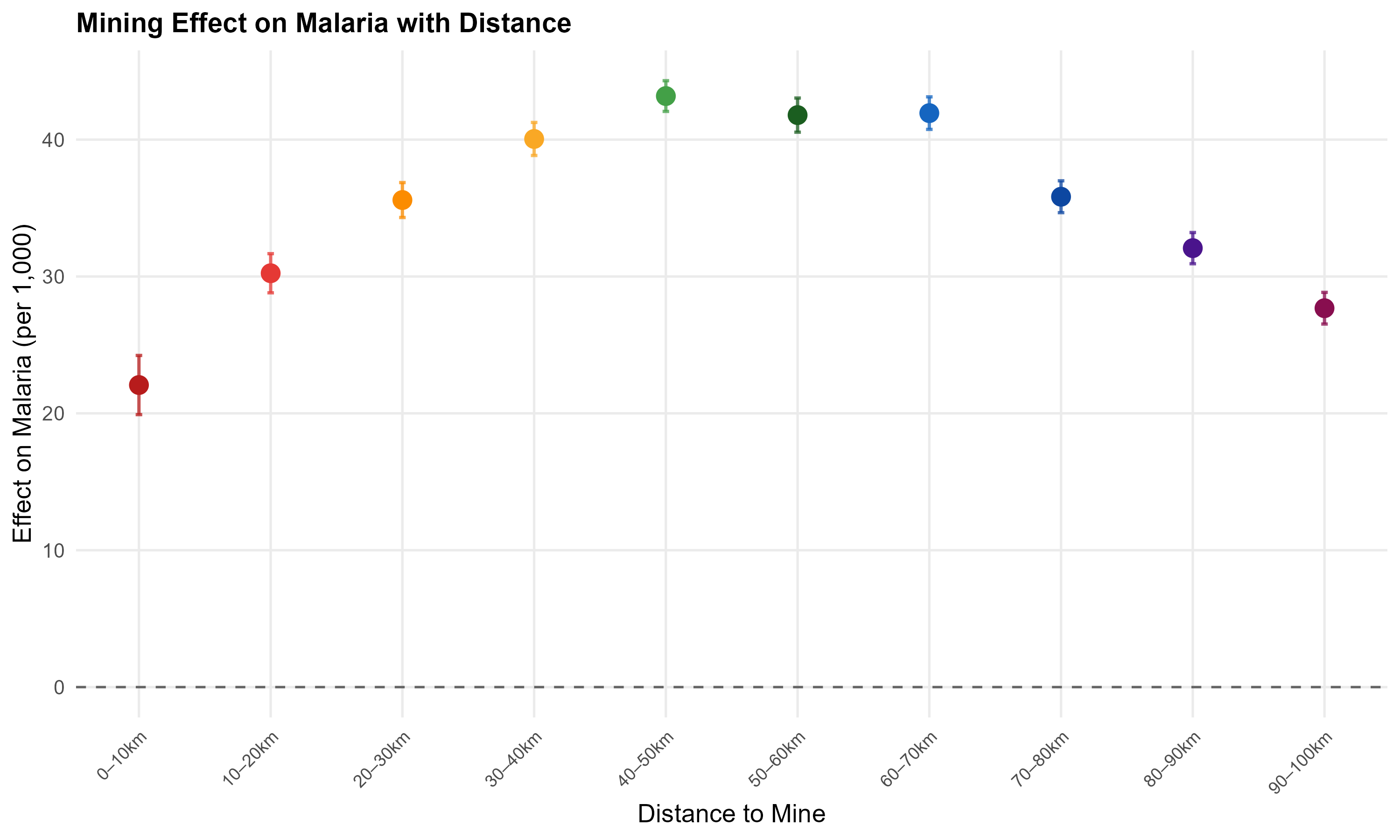
Result: Mining Discovered on Malaria Incidence (per 1,000)
Beyond the Mine Gate: Mining, Deforestation, and Malaria in Africa [Slides]
This paper estimates the health costs of industrial mining in Africa. Using 1.6 million grid-cell–year observations from 45 sub-Saharan African countries and a staggered difference-in-differences design, I show that mine discoveries increase malaria incidence, prevalence, and mortality. The effects are largest 10–50 km from mines, indicating substantial spatial spillovers. Over a 15-year mine horizon, mining adds 459 malaria cases per 1,000 people, 92.6 percentage points of prevalence, and 143 deaths per 100,000 in the average treated grid cell. Deforestation is the main mechanism and explains the especially large effects of artisanal gold mining. Electrification partly offsets these costs but mainly benefits richer households, leaving poorer households exposed to the disease burden.
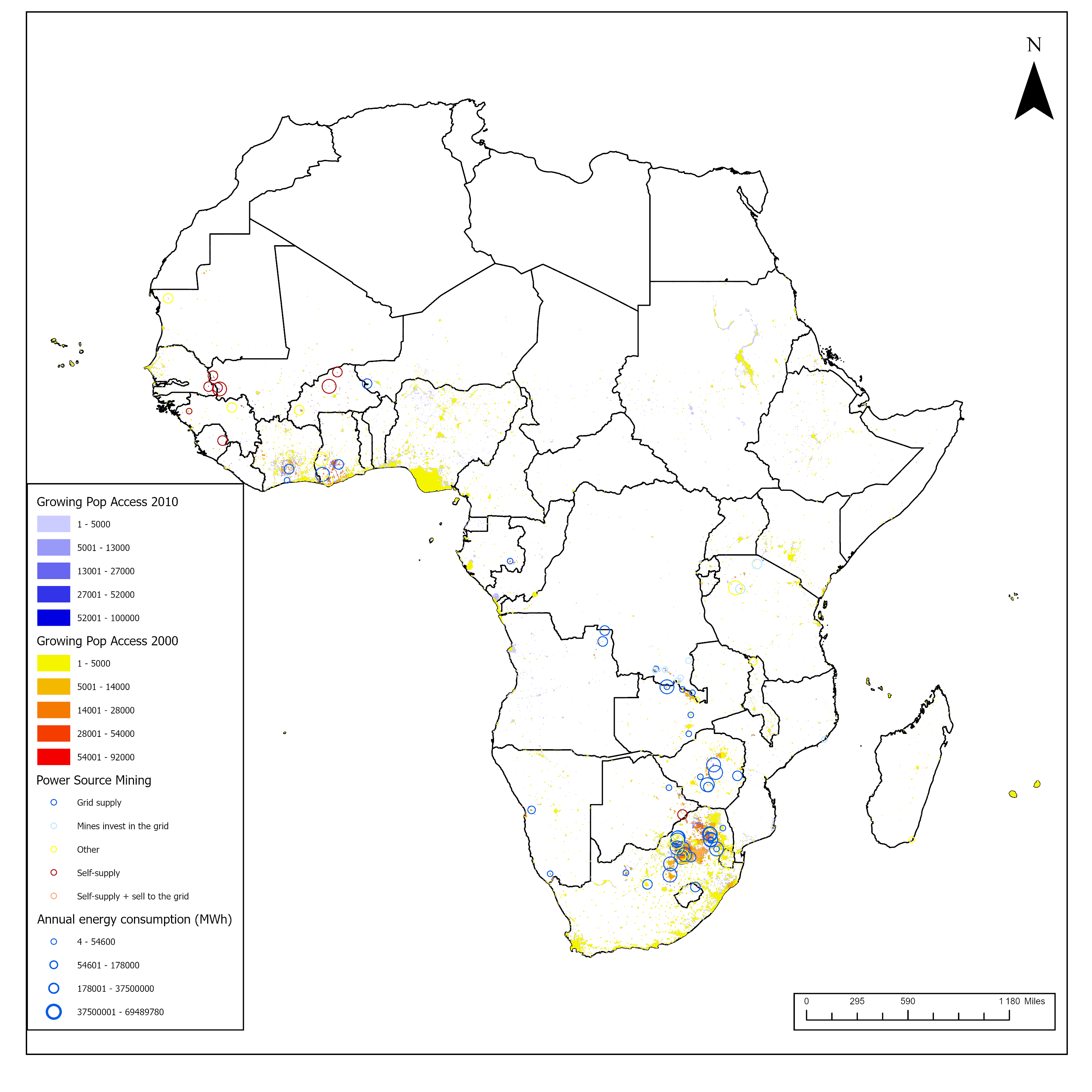
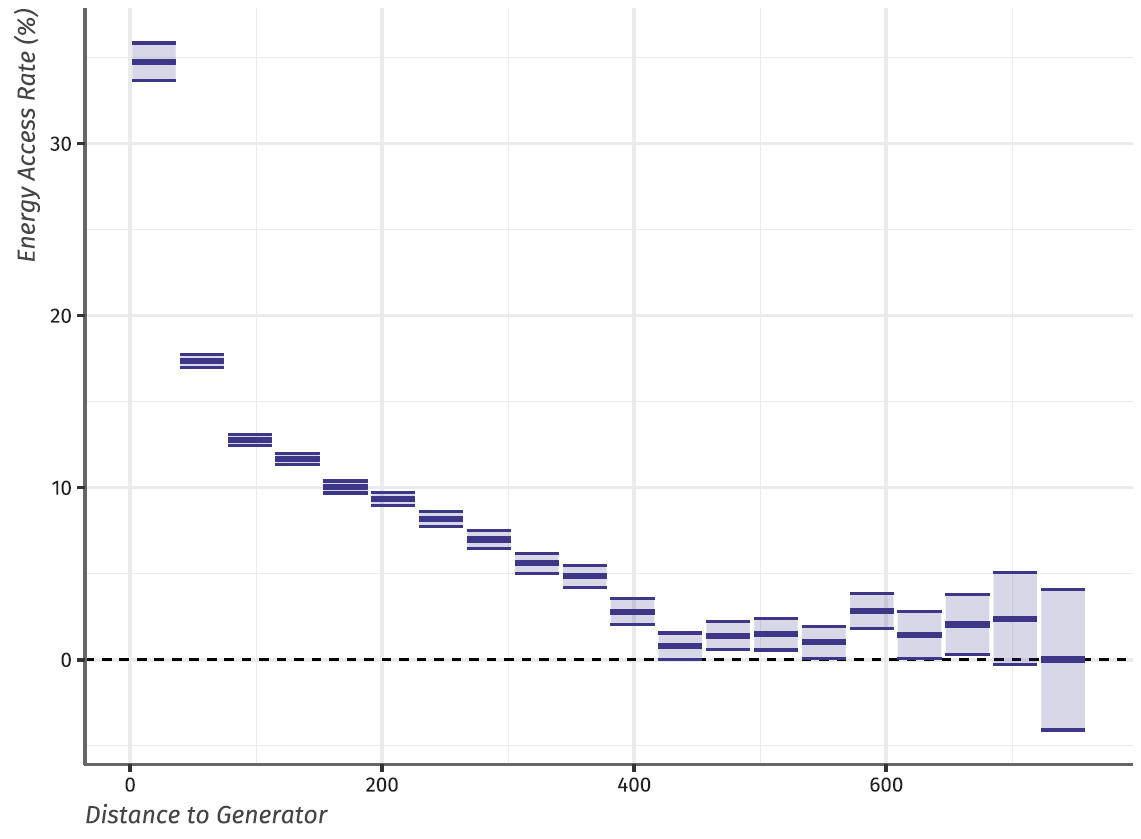
Discovery Mining & Energy Access · SSA
Mining and Power: Darkness or Lighting for Africa?
This study investigates the effect of mining activities involving 32 minerals on energy access (created using population and night lights at 1×1 km resolution) in sub-Saharan Africa from 2000 to 2022. Using georeferenced data in cells of 0.5°×0.5°, we compare energy access in areas with active mines to those with inactive mines, defined as sites that were discovered but were never active, serving as our control group. Our results indicate no evidence of active mines on energy access when using inactive mines for comparison. However, when all areas without mines are considered as the control group, the impact of mining activities appears significant and positive. Regions mining energy-intensive minerals like uranium and cobalt have the lowest energy access, while those mining gold have higher access rates. Mining areas exhibit enclave characteristics, with positive spillover effects on nearby regions.
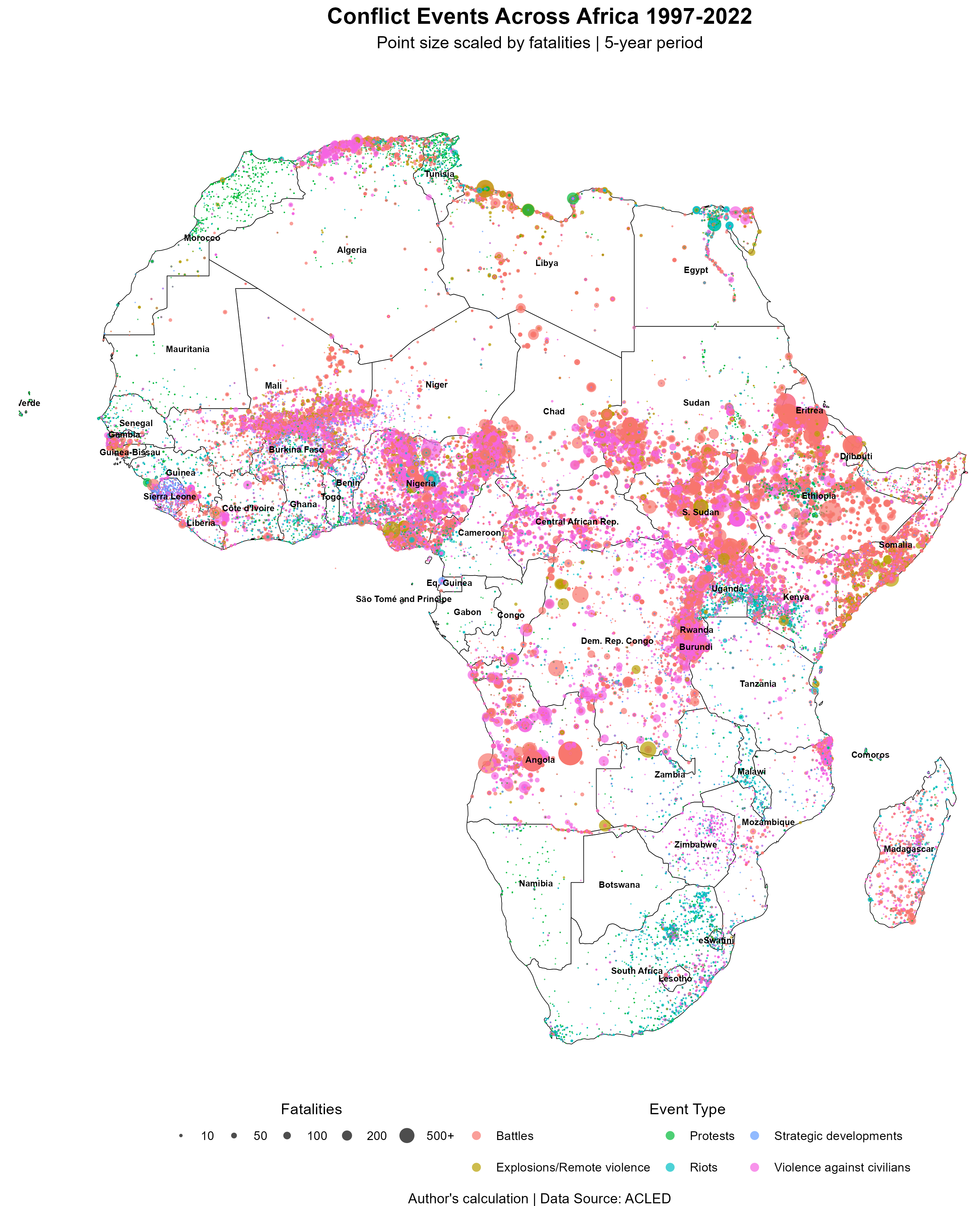
Conflict events in Africa · 1997–2022
The New Mining Rush: Mineral Discoveries and Social Conflicts in Africa
The global energy transition is crucial but presents social and political challenges, particularly in mineral-rich African countries. This study uses high-resolution data to explore the relationship between mining discoveries and conflict from 1997 to 2022. Using high-resolution remote sensing data combined with a dynamic panel and event-study approach, our findings indicate that conflict increases during exploration, primarily due to protests and riots over gold minerals. This escalation peaks during the Pre-Feasibility and Feasibility stages before continuing to rise after production starts. Conflict patterns vary by mine size, mineral type, and ownership. Mechanism analysis highlights local economic development and environmental degradation induced by mining, amplifying the risk of conflict and emphasizing the need for local engagement.
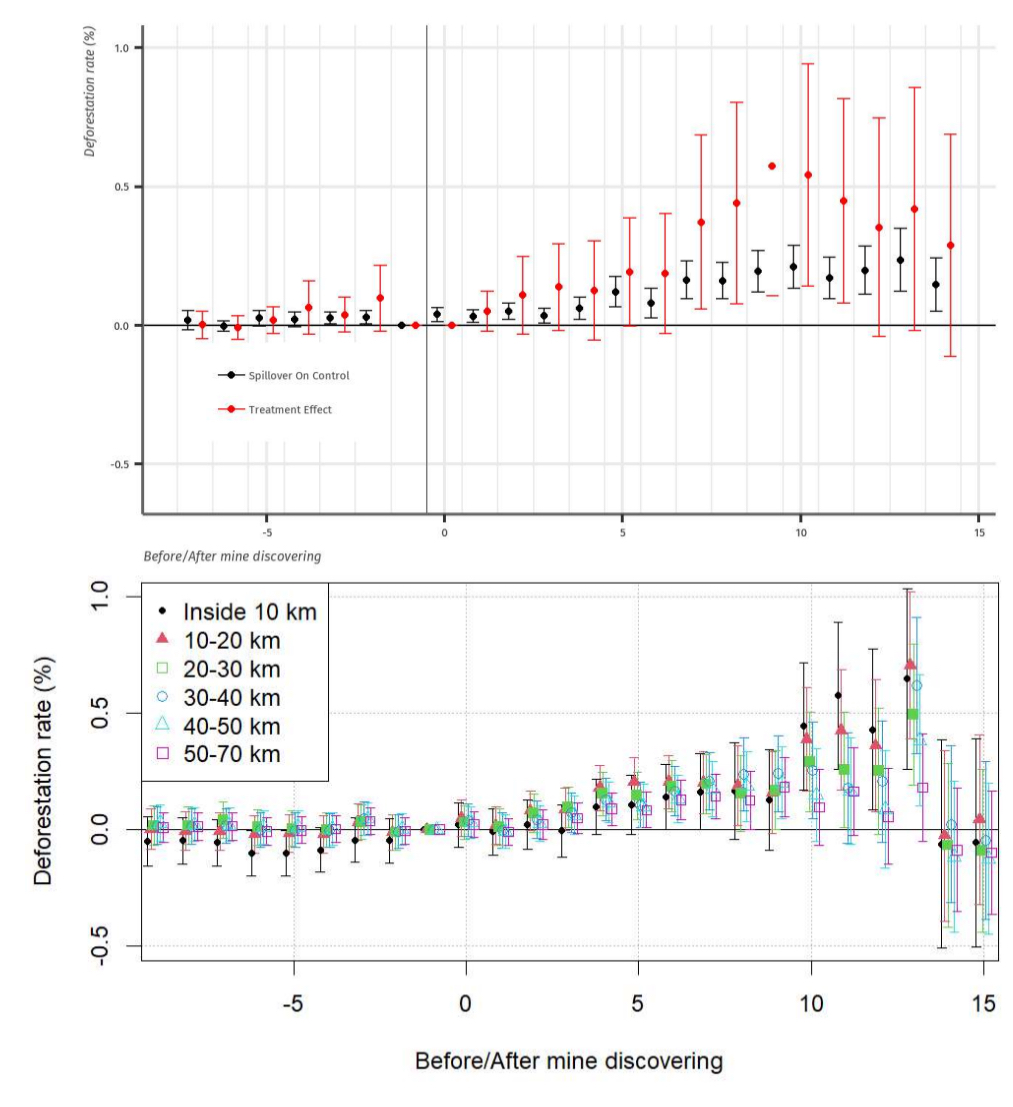
Deforestation rate before/after
mining discovery
Under the Canopy: Mining and Deforestation in Sub-Saharan Africa
This study examines the impact of mining on deforestation in Sub-Saharan Africa (2001–2018). Using geospatial data on 14 minerals and a Two-Way Fixed Effects Difference-in-Differences approach, we find that mining significantly increases deforestation, with indirect effects exceeding direct ones and extending up to 80 km from mining sites. Causal mediation analysis identifies key mechanisms, including agriculture, urbanization, infrastructure, and conflict. Results remain robust to global mineral price fluctuations and vary by mine size, mineral type, and ownership structure. Our findings highlight the broad environmental footprint of mining and the need for sustainable policies.
Work in progress
Mining, Local Governance, and Urbanization in Sub-Saharan Africa
with Rose Camille Vincent
Natural Disasters Kill Natural Resources: Is Mining Investment for Energy Transition at Risk?